Chronic lung disease triples lung cancer risk in non-smokers: Korean study < Hospital < Article
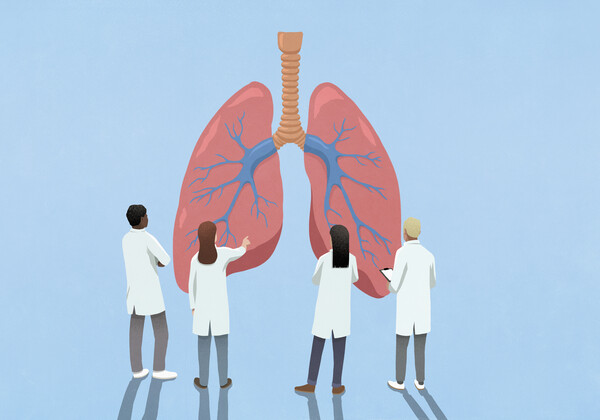
More than half of new lung cancer patients in East Asia, including Korea, are reported to be non-smokers, raising concerns that relying solely on smoking history has limitations in predicting and preventing the disease.
Korean medical professionals have identified key risk factors behind lung cancer in non-smokers, drawing attention to the need for broader screening criteria.
Samsung Medical Center (SMC) announced Tuesday that a joint research team has identified major risk factors influencing lung cancer development in Korean non-smokers.
The findings were based on a study that analyzed risk factors by pairing 3,000 non-smokers diagnosed with non-small cell lung cancer at Samsung Medical Center and Asan Medical Center (AMC) between 2016 and 2020 with 3,000 control subjects without lung abnormalities on a one-to-one basis.

Professors Kim Hong-kwan and Lee Jung-hee of the Department of Thoracic and Cardiovascular Surgery at SMC, along with Professor Ji Won-jun and resident Kwak Hyun-seok of the Department of Respiratory Medicine at AMC, jointly conducted the study.
The study found that the presence of chronic lung disease was the strongest risk factor for lung cancer in non-smokers. Even without a history of smoking, individuals with chronic obstructive pulmonary disease (COPD), pulmonary tuberculosis, or similar conditions had a 2.91-fold higher risk of developing lung cancer compared with the control group.
In particular, patients with COPD faced a 7.26-fold higher risk of developing lung cancer. The research team suggested that persistent chronic inflammatory responses in the lungs may contribute to cancer development in non-smokers.
Additionally, family history and socioeconomic factors were identified as significant risk factors. Analysis showed that having a first-degree relative with lung cancer increased the risk by 1.23-fold. The risk was especially pronounced when a sibling had a history of lung cancer, rising to 1.54-fold.
The study also found that the risk of lung cancer was 2.81-fold higher for residents outside the Seoul metropolitan area compared with those living in the greater Seoul area. Researchers suggested that industrial and environmental exposure differences, along with disparities in healthcare access, may contribute to this gap.
Unemployment was associated with a 1.32-fold increase in lung cancer risk, indicating that economic factors may influence health management and healthcare utilization.
“This study suggests that lung cancer in non-smokers arises from complex backgrounds involving underlying diseases, family history, and socio-environmental factors rather than a single cause,” Professor Ji said. “We need new prevention and treatment strategies that go beyond the existing smoker-focused screening system to identify high-risk groups, even among non-smokers.”
Professor Kim added, “Because of the perception that ‘lung cancer equals smoking,’ non-smokers tend to neglect their lung health.”
“Even if you do not smoke, if you have chronic lung disease or a family history of lung cancer, it is crucial to pursue early detection through regular screening and careful management,” he said.
link