5G in Healthcare Market Report 2026
Dublin, Jan. 26, 2026 (GLOBE NEWSWIRE) — The “5G in Healthcare Market – Global Industry Size, Share, Trends, Opportunity, and Forecast, 2021-2031” has been added to ResearchAndMarkets.com’s offering.
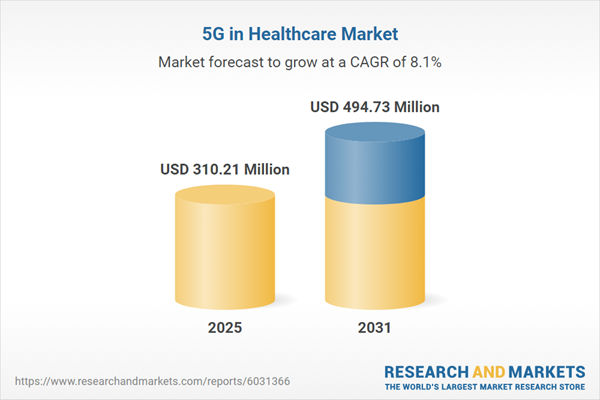
The Global 5G in Healthcare Market is projected to expand from USD 310.21 Million in 2025 to USD 494.73 Million by 2031, registering a CAGR of 8.09%
This market encompasses the utilization of fifth-generation cellular technology to enable sophisticated medical applications, such as telesurgery and remote patient monitoring, by leveraging high-speed data transmission and ultra-low latency. Key drivers propelling this sector include the urgent need for scalable remote care solutions, the handling of immense volumes of medical data, and the drive for operational efficiency within healthcare systems.
Supporting these economic benefits, CTIA reported in 2024 that 5G-driven innovation within the United States healthcare sector generated annual cost savings of $305 billion, indicating a fundamental structural shift toward connected health ecosystems rather than fleeting trends. Conversely, market growth faces substantial hurdles, primarily due to the significant capital expenditures needed for network infrastructure and the rigorous data security protocols required to safeguard patient privacy. Furthermore, regulatory inconsistencies across various jurisdictions hinder the smooth integration of these technologies. These obstacles demand considerable upfront investment and strict compliance measures, potentially delaying the broad implementation of 5G solutions, notwithstanding their ability to transform the healthcare industry.
Market Drivers
A major force driving the Global 5G in Healthcare Market is the rapid growth of telehealth and remote consultation services, which necessitate ultra-low latency networks to facilitate high-definition video consultations and real-time monitoring, especially in isolated areas. As providers work to close the health equity gap, 5G supplies the essential bandwidth to extend specialist care beyond traditional facilities. Ericsson projected that global 5G subscriptions would hit 2.3 billion in 2024, establishing the digital infrastructure needed for these systems.
Reinforcing this trend, the ‘Future Health Index 2024’ report by Philips in June 2024 noted that 32% of global healthcare leaders view virtual care as a means to extend specialist services to underserved communities, allowing health systems to sustain patient engagement regardless of geography.
The increasing demand for the real-time transmission of massive medical data files also accelerates adoption, particularly as diagnostics produce large datasets that overwhelm legacy networks. Pathology departments rely heavily on 5G to instantly transmit high-resolution scans for analysis, a capability essential for AI-driven diagnostics where processing speed directly influences clinical results. For instance, Huawei’s February 2024 ‘Medical Technology Digitalization Solution’ announcement highlighted that 5G infrastructure at Ruijin Hospital enabled simultaneous access to 1,000 pathological sections within a second, increasing retrieval speeds by 80 times. Such progress illustrates how 5G removes data bottlenecks, fostering collaboration and enabling the practical use of precision medicine tools.
Market Challenges
The strict data security protocols required to ensure patient confidentiality pose a significant barrier to the growth of the Global 5G in Healthcare Market. Because 5G technology drastically increases the number of connected endpoints via the Internet of Medical Things (IoMT), it inadvertently broadens the attack surface for cyber threats. Consequently, healthcare providers must constantly assess and strengthen their defenses rather than prioritizing aggressive network expansion. This defensive stance retards the integration of advanced connectivity solutions, as the liability risks associated with compromising sensitive medical records are too severe to overlook.
The severity of this threat is directly linked to the cautious pace of market adoption, as health systems facing persistent cyber risks divert resources toward compliance and protection instead of innovation. In 2024, the American Hospital Association reported that the healthcare sector filed 592 regulatory reports regarding data breaches, impacting roughly 259 million Americans. This high frequency of security incidents underscores the industry’s hesitation to fully adopt open, connected ecosystems without first implementing exhaustive, and frequently costly, protective measures.
Market Trends
The adoption of private 5G networks for secure and dedicated smart hospital infrastructure is rising as a crucial trend to overcome the security and reliability limitations of public networks. Private 5G grants healthcare institutions full control over bandwidth allocation, ensuring uninterrupted connectivity for mission-critical equipment, such as robotic surgical tools and life-support systems. This approach enables hospitals to isolate sensitive patient data from general network traffic, directly reducing cybersecurity risks linked to the growing number of connected devices. Supporting this shift, Nokia’s January 2025 ‘Financial Report for Q4 and Full Year 2024’ confirmed the company had secured 850 private wireless customers globally, indicating strong growth in enterprise connectivity solutions for high-demand sectors like healthcare.
Concurrently, the convergence of high-bandwidth 5G networks with artificial intelligence for predictive diagnostics is revolutionizing clinical decision-making. High-speed 5G connectivity permits the real-time transmission of complex physiological data to AI engines, facilitating immediate analysis and predictive alerts without latency issues. This integration powers advanced applications, including generative AI models that help clinicians instantly synthesize patient histories, evolving beyond mere data transmission to intelligent, real-time interpretation.
Highlighting this strategic focus, the ‘Future Health Index 2024’ report by Philips in June 2024 revealed that 85% of healthcare leaders globally are currently investing in or planning to invest in generative AI technologies to bridge the gap between massive data generation and actionable clinical insights.
Key Players Profiled in the 5G in Healthcare Market:
- AT&T Intellectual Property
- Verizon
- China Mobile International Limited
- Quectel
- Telit Cinterion
- TELUS International
- Huawei Technologies Co., Ltd.
- Cisco Systems, Inc.
- Orange
- NEC Corporation
5G in Healthcare Market, by Component:
5G in Healthcare Market, by Application:
- Remote Patient Monitoring
- Connected Medical Devices
- AR/VR
- Connected Ambulance
- Asset Tracking
5G in Healthcare Market, by End Use:
- Healthcare Providers
- Healthcare Payers
- Other
5G in Healthcare Market, by Region:
- North America
- Europe
- Asia-Pacific
- South America
- Middle East & Africa
Key Attributes:
| Report Attribute | Details |
| No. of Pages | 182 |
| Forecast Period | 2025 – 2031 |
| Estimated Market Value (USD) in 2025 | $310.21 Million |
| Forecasted Market Value (USD) by 2031 | $494.73 Million |
| Compound Annual Growth Rate | 8.0% |
| Regions Covered | Global |
For more information about this report visit
About ResearchAndMarkets.com
ResearchAndMarkets.com is the world’s leading source for international market research reports and market data. We provide you with the latest data on international and regional markets, key industries, the top companies, new products and the latest trends.

link